
In a world that often moves too fast, it is easy to focus on problems, stress, and the things that are missing from our lives. Deadlines, responsibilities, and constant comparison can slowly train the mind to notice what is wrong rather than what is good. Over time, this pattern can affect our mood, mental health, and overall sense of life satisfaction.
This is where gratitude becomes incredibly powerful.
Gratitude is more than simply saying “thank you.” It is a mental habit that shifts your attention toward appreciation. When practiced regularly, gratitude helps the brain recognize positive experiences that would otherwise go unnoticed.
People who actively practice gratitude often experience greater happiness, stronger relationships, better emotional resilience, and improved overall well-being. At the same time, gratitude can help reduce the intensity of negative emotions such as anxiety, anger, and sadness.
While gratitude does not magically remove life’s challenges, it can significantly change how we respond to them. By training the mind to notice moments of goodness, gratitude creates balance in our emotional experience and helps us stay grounded even during difficult times.

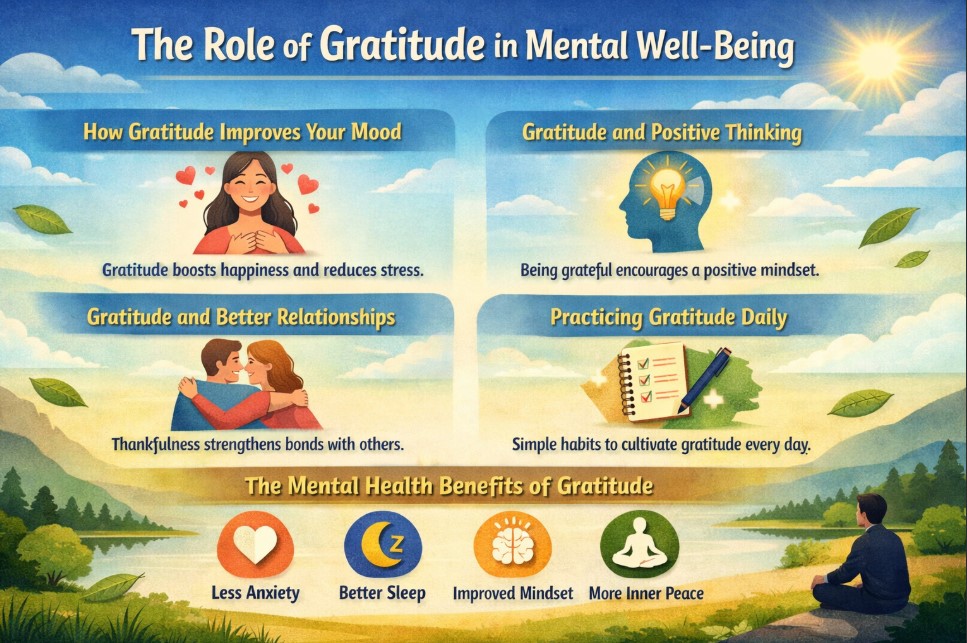
Gratitude improves mental health by boosting happiness, reducing stress, and promoting positive thinking
Understanding the Connection Between Gratitude, Anxiety, and Depression
How Negative Thinking Affects Mental Health
Anxiety and depression are complex mental health conditions that affect millions of people worldwide. Although they appear in different forms, they often share a common feature: patterns of negative thinking.
Negative thinking can influence both what we think about and how we think about it.
Many people struggling with anxiety or depression experience thought patterns such as:
- Focusing heavily on problems or negative events
- Ignoring or minimizing positive experiences
- Expecting the worst possible outcome
- Doubting their own abilities or worth
Psychologists often refer to this as negativity bias, the brain’s natural tendency to give more attention to negative experiences than positive ones.
While this bias may have helped humans survive in ancient times by making us more alert to danger, in modern life it can create unnecessary emotional stress.
When the mind repeatedly scans for problems, it begins to interpret everyday situations through a negative lens. Small setbacks feel overwhelming, and positive moments may be quickly dismissed.
Over time, this mental pattern can strengthen feelings of worry, hopelessness, and emotional exhaustion.
The Habit of Mental Time Travel
Another major contributor to anxiety and depression is something psychologists sometimes call mental time travel.
This happens when the mind constantly moves away from the present moment and becomes stuck in either:
- Rumination about the past
- Worry about the future
Rumination involves replaying past mistakes, regrets, or painful experiences over and over again. The mind analyses them repeatedly, often without reaching any helpful conclusion.
Worry about the future, on the other hand, focuses on imagined scenarios that may never actually happen. The brain begins preparing for possible threats, creating stress and tension in the process.
Both rumination and worry pull attention away from the present moment. And research suggests that people tend to feel happier when their minds are focused on the present, even if the moment itself is not perfect.
Unfortunately, once these mental habits form, they can become automatic. The mind slips into negative loops without conscious awareness.
That is where gratitude can make a meaningful difference.
Gratitude as a Powerful Mental Shift
The Idea of a “Competing Response”
In behavioural psychology, there is a technique known as Habit Reversal Training (HRT). This method is often used to help people replace unwanted habits with healthier behaviours.
One important element of this method is something called a competing response.
A competing response is an action that makes the unwanted habit difficult or impossible to perform at the same time.
For example, someone trying to stop nail biting might clasp their hands together when they feel the urge. Since it is difficult to bite your nails while your hands are clasped, the brain slowly learns a new pattern.
This same concept can apply to mental habits.
Negative thinking, complaining, worrying, and rumination are not just thoughts, they are habits of the mind. And like other habits, they can be replaced with healthier mental responses.
Gratitude can serve as one of those responses.
How Gratitude Interrupts Negative Thinking
When you actively focus on something you appreciate, your brain temporarily shifts away from negative thought loops.
It becomes surprisingly difficult to feel deep gratitude and intense negativity at the same time.
For example, if you pause and genuinely reflect on something meaningful in your life, a supportive friend, a peaceful moment, or even a small comfort, it naturally changes your emotional state.
This shift works in two ways:
- It interrupts negative thought patterns
- It brings your attention back to the present moment
Instead of mentally traveling to past regrets or future fears, gratitude anchors your mind in what is happening right now.
Over time, regularly practicing gratitude can train the brain to notice positive experiences more easily. This does not mean ignoring problems or pretending everything is perfect. Rather, it helps create balance in how we interpret life events.
Even during stressful periods, moments of appreciation can act as emotional anchors that prevent the mind from spiralling into negativity.
Practical Ways to Practice Gratitude Daily
Building a gratitude habit does not require dramatic changes to your routine. Often, small and consistent practices work best.
Here are a few simple ways to bring gratitude into everyday life.
Keep a Gratitude Journal
One of the most popular gratitude practices is journaling.
At the end of each day, write down three things you are grateful for. They do not have to be major life achievements. In fact, the smallest moments often matter the most.
Examples might include:
- A good conversation with a friend
- A peaceful walk outdoors
- A warm cup of tea after a long day
Over time, this exercise trains your mind to notice positive moments throughout the day.
Pause and Reflect During Difficult Moments
Gratitude can be especially powerful when used during stressful situations.
When you notice yourself becoming overwhelmed with negative thoughts, pause and gently ask yourself:
“What is one thing in this moment that I appreciate?”
It might be something simple like:
- Having access to clean water
- A supportive message from someone you care about
- A quiet moment to breathe and reset
This small shift can help calm your mind and reduce emotional intensity.
Express Gratitude to Others
Gratitude becomes even more powerful when it is shared.
Take time to tell people in your life that you appreciate them. A short message, a sincere compliment, or a thank-you note can strengthen relationships and improve emotional well-being for both people involved.
Human connection is one of the strongest contributors to mental health, and gratitude helps nurture those connections.
When Gratitude Is Misused
Although gratitude is beneficial, it can sometimes be misunderstood.
Some people unintentionally turn gratitude into a source of guilt.
For example, someone might think:
“I shouldn’t feel sad. My life is better than many others.”
Or:
“I have so much to be grateful for, so why am I still struggling?”
Thoughts like these can make people feel ashamed of their emotions.
But gratitude is not meant to invalidate pain.
Mental health struggles such as anxiety and depression are not signs of being ungrateful. They are complex experiences influenced by many psychological and biological factors.
Gratitude should never be used as a tool for self-criticism.
Gratitude and Pain Can Coexist
One of the healthiest ways to approach gratitude is through a “both-and” mind-set.
This means recognizing that two emotional experiences can exist at the same time.
You can feel grateful and still feel sad.
You can appreciate parts of your life while also struggling with difficult emotions.
For example:
- You might miss loved ones deeply and feel grateful for technology that helps you stay connected.
- You might feel anxious about upcoming changes and appreciate the support of close friends.
- You might feel overwhelmed by responsibilities and feel thankful for opportunities or relationships.
Gratitude does not erase hardship. Instead, it provides emotional balance and perspective during challenging times.
The Long-Term Benefits of Gratitude
Over time, gratitude can have a significant impact on both mental and physical health.
People who regularly practice gratitude may experience:
- Lower levels of stress and anxiety
- Improved mood and emotional resilience
- Better sleep quality
- Stronger relationships
- Increased overall life satisfaction
The key is consistency. Like any mental skill, gratitude becomes stronger with practice.
Even a few minutes each day can gradually reshape the way your brain interprets experiences.
Conclusion
Gratitude is not a quick fix for life’s challenges, but it is a powerful mental habit that can transform how we experience the world.
By shifting attention toward appreciation, gratitude helps interrupt negative thinking patterns and bring the mind back to the present moment. It encourages emotional balance, strengthens resilience, and allows us to find meaning even during difficult times.
Most importantly, gratitude reminds us that life is rarely purely good or purely bad. It is usually a mixture of both.
Learning to acknowledge struggles while still appreciating moments of goodness can make a profound difference in our mental well-being.
Frequently Asked Questions (FAQs)
In psychology, gratitude refers to the practice of recognizing and appreciating the positive aspects of life. It involves acknowledging benefits received from others, circumstances, or everyday experiences.
Yes. Practicing gratitude can help shift attention away from negative thoughts and worries. By focusing on positive experiences, individuals may experience reduced stress and improved emotional balance.
Many experts recommend practicing gratitude daily. Even spending a few minutes reflecting on positive moments or writing in a gratitude journal can provide mental health benefits over time.
Gratitude can support emotional well-being and may help reduce some symptoms of depression. However, it should be viewed as a supportive practice rather than a replacement for professional mental health treatment.
Simple gratitude practices include keeping a gratitude journal, expressing appreciation to others, reflecting on positive moments during the day, and taking time to notice small joys in everyday life.