















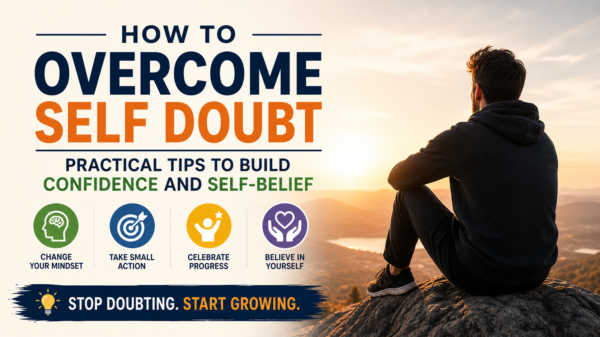


Your biggest enemy doesn’t live outside; it lives in your head, and it goes by the name of self-doubt
The self-doubt may become a significant barrier to success and happiness. whether it is questioning your capacities at work, doubting yourself in relationships, or constantly feeling that you are not good enough.
The positive side of the matter is that it is possible to learn how to overcome self-doubt. By having the right attitude, confidence-building habits, and practical self-confidence tips, you can get yourself out of the negative thoughts that take control of your life and begin to trust yourself again.
What Is Self-Doubt?

Simple strategies to overcome self-doubt and build confidence
Self-doubt is the inability to trust yourself, your choices, and your values. It is usually as a result of the negative thoughts, fear of failure, low self-esteem, or past experiences that made you question yourself.
When people are dealing with self-doubt, they may often think:
- “I am not good enough”.
- “What if I fail?”
- “There are better people than I am.
- “I never take the right decisions”.
Such thoughts reinforce your inner critic and make it more difficult to take a step.
What Causes Low Self-Esteem
The low self-esteem will make it hard to trust oneself and outline his/her strengths. There are some typical reasons, such as:
1. Fear of Failure
Most individuals do not want to take opportunities due to fear of errors. Such fear instills reluctance and hinders development.
2. Negative Past Experiences
The previous failures, criticisms, or rejections may leave long-lasting limiting beliefs that will influence your confidence even now.
3. Comparing Yourself with Others
Comparing yourself with others all the time, on social media or in real life, can be harmful to self-acceptance and make you feel inferior.
4. Perfectionism
In an attempt to be perfect, disappointment is inevitable since it is not realistic that we can be perfect.
Powerful Ways to Rise Above Low Self-Esteem
These are practical strategies that can assist you in knowing how to overcome self-doubt in life.
1. Challenge Negative Thoughts
At times, your mind may turn into your greatest adversary. Rather than believing all the negative thoughts, challenge them. Ask yourself:
- Is it true that this thought is true?
- Do I have proof?
- Would I tell a friend this?
2. Emphasize Progress, Not Perfection
Perfection creates pressure. Progress creates growth. Rather than attempting to perform excellently, enjoy small successes.
Each progressive move creates confidence, growth, and resilience of the mind.
3. Build Self-Awareness
Self-awareness can assist you in knowing your triggers and emotional patterns. Be aware of occurrences of self-doubt:
- Before important decisions?
- During work presentations?
- In relationships?
Being aware of your patterns will assist in controlling them in a better way.
4. Practice Positive Self-Talk
Words are important, and more so the ones you utter to yourself. Replace:
“I can’t do this,” with I am growing and getting better each day.
These tips on a positive mindset enhance emotional resilience, motivation, and discipline.
5. Stop Comparing Yourself
You do not go on the same voyage as any other. Competing takes away confidence and generates unwarranted pressure.
Be more concerned about your own process of self-improvement rather than the highlight reel of someone that you are not.
6. Take Small Action
Confidence builds by doing and not waiting. Even minor steps can assist:
- raising voices during meetings.
- deciding something without thinking a lot.
- trying something new
These mini-victories make your brain believe that you can.
7. Learn from Failure
Loss is not an indication that you are not good enough. It is evidence that you are making attempts.
Those people who get rid of fear comprehend that errors are a part of developing. All failures are valuable lessons to be learned. According to Psychology Today, building confidence is an ongoing process that requires consistent effort and self-compassion.
8. Keep Supportive People Around You
Having positive individuals around enhances acceptance of self and assists in diminishing self-blame.
Select the relationships that will stimulate your development and not those that will continuously raise your suspicions.
Simple Ways to Boost Confidence
To achieve long-term outcomes, daily practices are significant.
- List 3 things you did each day that you are proud of.
- Have minimal and attainable objectives.
- Exercise regularly
- Practice gratitude daily
- Restrict negative use of social media.
- Read self-development books.
- Work on your posture and body language.
- Celebrate your progress
These are the confidence-building habits that gradually build self-belief with time.
How to Stop Doubting Yourself at Work
Self-doubt at work is quite normal, particularly when one is taking a new position or is in trouble.
Practical Tips
- Prepare before meetings
- Keep track of your achievements
- Do not be afraid to ask questions.
- Do not think that others are superior to you.
- Realize that learning is a process.
Growth in a profession needs confidence, and in most cases, confidence comes after the action. To stay consistent, it also helps to know how to stay motivated at work.
How to Overcome Insecurity in Your Relationships
Self-doubt in relationships is mostly due to insecurity or fear of being rejected.
Healthy Relationship Tips
- Communicate honestly
- Do not overthink everything.
- Establish self-trust before others.
- Stop needing to be validated all the time.
- Understand your self-worth
Knowing how to have faith in yourself enriches every relationship in your life.
Final Thoughts
This is not the way to grow up to be fearless, but learning how to overcome self-doubt. It is concerned with taking steps in spite of fear.
There is no way that self-doubt will ever go away, but it does not need to dominate your life.
Through challenging negative thoughts, developing self-awareness, exercising self-acceptance, and taking small daily actions, you can build confidence and self-belief that can last. If you’re also dealing with a low mood, addressing that alongside self-doubt can make a real difference.
Frequently Asked Questions (FAQs)
Begin by recognizing your negative thoughts and disputing them. Pay attention to the facts rather than fear, and practice positive self-talk.
Self-doubt often comes from past experiences, fear of failure, negative thinking, or low self-esteem. Constant comparison with others and perfectionism can also make self-doubt worse over time.
Self-doubt cannot always be eliminated, but it can be managed effectively. With the right mindset and habits, you can reduce its impact and prevent it from controlling your decisions.