
What if the biggest obstacle to your happiness isn’t your circumstances, but the way you’re thinking about them?
There is very little aspect of our lives that is not affected by our thoughts. Situations, self-talk, and thinking about the future influence emotions and behavior. With a negative mindset, the mind can begin to impact mental health, confidence, and overall wellness.
There is more to negative thinking than simply having a bad day or being pessimistic occasionally. A state of mind in which a person expects the worst, fixates on problems, and doubts their abilities. This negative thinking can lead to fatigue when it comes to small challenges over time.
The effects of negative thinking on mental health can be profound. Can lead to stress, anxiety, low self-esteem, and even depression if it becomes a habit. Fortunately, negative thinking patterns are detectable and can be modified.
This article will delve into the impact of negative thinking on mental well-being, reasons why people engage in negative thinking, signs to look for, and effective strategies to break negative thinking patterns and cultivate a healthier mindset.
How a Negative Mindset Affects Your Mind
If he sees only the bad, he’s thinking in a negative way. Rather than looking at potentials or opportunities, they were always looking for failure, rejection, or disappointment.
This sort of attitude may gradually influence emotional stability and trigger lasting psychological strain.
Increased Risk of Depression
Negative thinking is one of the most harmful consequences that depression can have. These thoughts can then become feelings of pessimism if people keep thinking this way over and over again, and that they are not good enough to change.
Over time, they can become demotivated and come to believe that their work will not yield any positive outcomes. This state of hopelessness can cause continued sadness and emotional exhaustion.
Living in a State of Constant Worry
Negative thinking leads to a cycle of anxiety. On the other hand, those who tend to think in worst-case terms will always have the fear of what could happen to them.
For instance, the following may be assumed:
“What if I fail?”
“What if others make judgments about me?
“There’s going to be some kind of disaster.”
Such thoughts keep the brain in a vigilant state, even in the absence of genuine danger. As a result, individuals may feel restless, tense, or mentally exhausted.
Long-Term Stress
One of the other prevalent outcomes of negative thinking is chronic stress. If the brain continues to be alert to hazards or problems more often than they need to be, the body is also responding to stress more often than it should.
This increases the production of cortisol, a hormone associated with stress. Chronically high cortisol may cause feelings of fatigue, irritability, and weakness.
The Cycle of Negative Thinking
Negative thinking has a tendency to repeat certain patterns and may be hard to break. When they get into this pattern, they begin to think, feel, and act in a way that reinforces itself.
Trigger Event
The pattern typically begins with a stressful and discouraging event. This may be a small incident, e.g., an error in the workplace, or a larger incident, e.g., failure or rejection.
Negative Interpretation
The mind does not think realistically and comes up with extreme notions like:
“I’m a failure.”
“Nothing’s working out for me.”
“It’s always been a problem with me.”
Emotional Reaction
Thoughts trigger feelings of embarrassment, guilt, sadness, or anxiety.
Behavioural Response
These feelings intensify and can lead to avoidance of challenges and/or withdrawal from opportunities. They might delay tasks, stop making efforts, or withdraw socially.
Validation of Negative Self-Beliefs
Steering clear of situations can reinforce negative perceptions. When someone turns away from a difficulty, it can seem to them that it is substantiating their fear of not being able to or not being good at.
This pattern must be broken if mental health and emotional balance are to be maintained over the long-term.
Negative Thinking Stems From Within Us

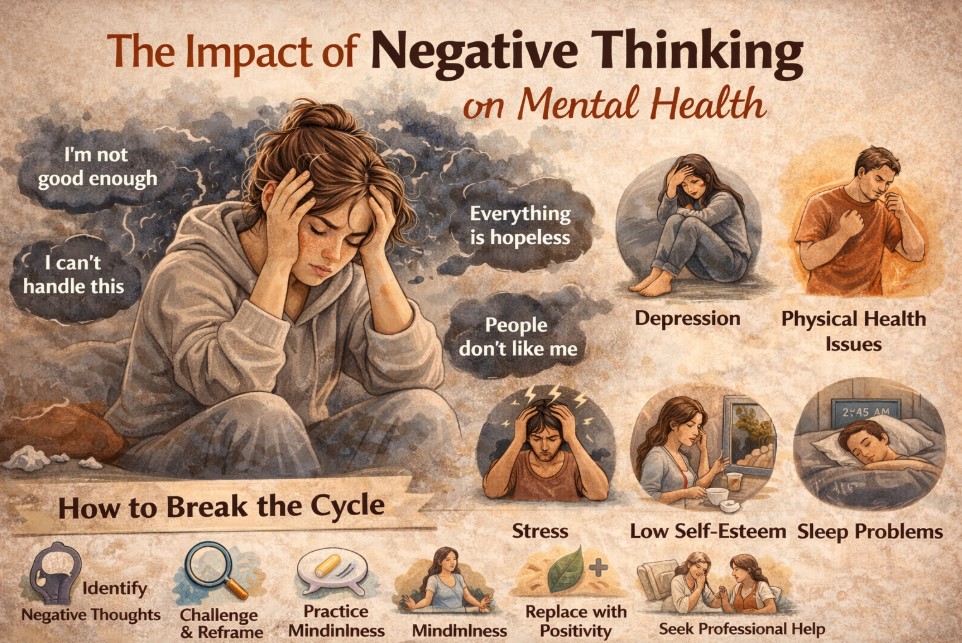
How negative thinking affects mental health and ways to develop a positive mindset
Negative thinking patterns typically take years to develop and are a result of experiences, environment, and personality.
Early Life Experiences
A lot of people get into negative thinking patterns while they are children. Mistakes made by parents, teachers, or peers can affect how a person feels about himself or herself.
For instance, if a child hears comments such as “You’re not good enough” frequently, that may lead him or her to think that the comments are a true reflection of his or her abilities.
Social and Cultural Pressure
Success, achievement, and appearance are very important in modern society. It can get worse on social media, as people tend to present a very polished version of their lives.
Negative thinking can be reinforced by the feeling of being behind or failing to meet standards due to the constant comparison.
Personality and Self-Esteem
There are some personality traits that also predispose individuals to negative thinking. Someone who has perfectionism or poor self-esteem will focus on what they don’t have instead of what they have.
This tendency to dwell on negatives can foster negative thinking over time.
Common Signs of Negative Thinking
The first step to changing negative thinking patterns is to identify them. These thoughts sometimes come in a clear manner, at other times they come in a more subtle way.
Black-and-White Thinking
This occurs when individuals see things in black and white, as a success or a failure.
Such as: “If it wasn’t flawless, I did an awful job.”
Catastrophizing
Catastrophizing is when individuals make the worst-case-scenario assumption despite having little evidence to back it up.
Excessive Self-Blame
Others take responsibility for things that are not in their power. They may think that they can be responsible for issues that have many factors.
Persistent Self-Doubt
Common negative thought patterns include repeatedly thinking things such as ‘I’m not smart enough’ or ‘I will probably fail at this.’
Once these thoughts are identified, people have the opportunity to be curious about them and alter their meaning.
The Physical Effects of Negative Thinking
Negative thinking doesn’t only affect emotions. It also has an impact on the body and brain. Negative thinking signals the body to go into stress mode, or what is called the hypothalamic-pituitary-adrenal (HPA) axis. This reaction raises the level of cortisol and perpetuates chronic tension.
Sleep Problems
Constant worrying and stress can make it hard to relax and sleep.
Weakened Immune System
Persistent stress can compromise the immune system, leaving the body open to disease.
Reduced Mental Clarity
Negative thoughts may affect our recall, concentration, and judgment. Fortunately, the brain is very malleable in the sense that it adapts and develops new thinking patterns over time.
Practical Techniques for Blocking Negative Thoughts
It takes time to change negative thinking patterns, but it’s a pattern that can be altered by small steps taken every day.
Practice Mindfulness
One of the benefits of mindfulness is that a person can become conscious of their thoughts without reacting to them. Mindfulness teaches people to observe the negative thoughts and then drop them.
Challenge Negative Thoughts
If you notice a negative thought, ask yourself a couple of simple questions:
Is this considered a fact or an assumption? Am I making this up? How would I counsel a friend who was in a similar situation?
This process contributes to developing balanced thinking.
Keep a Journal
Sometimes, having ideas written down helps them to be better understood. Using journaling to uncover patterns and triggers for negative thinking. This, over time, fosters more positive attitudes.
Consider Professional Support
Talking to a mental health professional can be beneficial if you feel overwhelmed by negative thinking or if the negative thinking is ongoing. Cognitive Behavioural Therapy (CBT) is a therapy tailored to identify and alter negative thinking.
The Strength of Positive Thinking
Positive thinking is not about avoiding life’s problems. Rather, it involves facing challenges with a level, positive mindset. Adopting positive thinking habits can positively affect mental health in some ways.
Lower Stress Levels
Positive thinking lowers stress hormones and helps to relax.
Improved Self-Confidence
Fostering inner dialogue can boost self-confidence and self-motivation.
Greater Emotional Resilience
Individuals who believe in positive thinking can bounce back from failures and gain insights. For instance, changing the thought from “I’ll never succeed” to “I can get better if I practice” promotes growth rather than discouragement.
They begin to understand why negative thinking is a problem and how they can change. Thoughts can have a negative influence on a person’s emotions without him realizing it. It can lead to feelings of anxiety, depression, and chronic stress when it becomes a habit.
These patterns are not permanent, however. By becoming aware of negative thoughts, questioning them, and practicing healthier thinking habits, individuals can gradually change their mindset. Small activities such as mindfulness practice, journaling, and therapy can have a positive impact in the long term.
Any action taken to change negative thinking and create a positive mindset improves mental well-being and a balanced life.
Frequently Asked Questions (FAQs)
What is negative thinking?
Negative thinking is a thought pattern in which one consistently has negative thoughts, doubts their skills, or believes there will be something bad in other scenarios.
Does negative thinking have an impact on mental health?
Yes. Negativity can lead to anxiety, depression, stress, and low self-esteem. It may make things seem harder over time.
What is the reason behind negative thinking?
Negative thinking may stem from adverse childhood events, peer pressure, poor self-esteem, perfectionism, or from facing criticism over and over again.
What to do to overcome negative thinking?
To minimize negative thinking, try the following: practicing mindfulness, challenging negative thoughts, maintaining a journal, and seeking professional help as necessary.
Does having a positive mindset benefit?
With positive thinking, you can build emotional resilience, reduce stress, and gain more confidence in yourself. It assists people in being more balanced and positive thinkers in taking on challenges.